

Your identity is no longer just what you reveal. It is what artificial intelligence can predict about you. Our digital identity is shaped by both the data we share and what is inferred from it. How does AI privacy affect our digital identity?
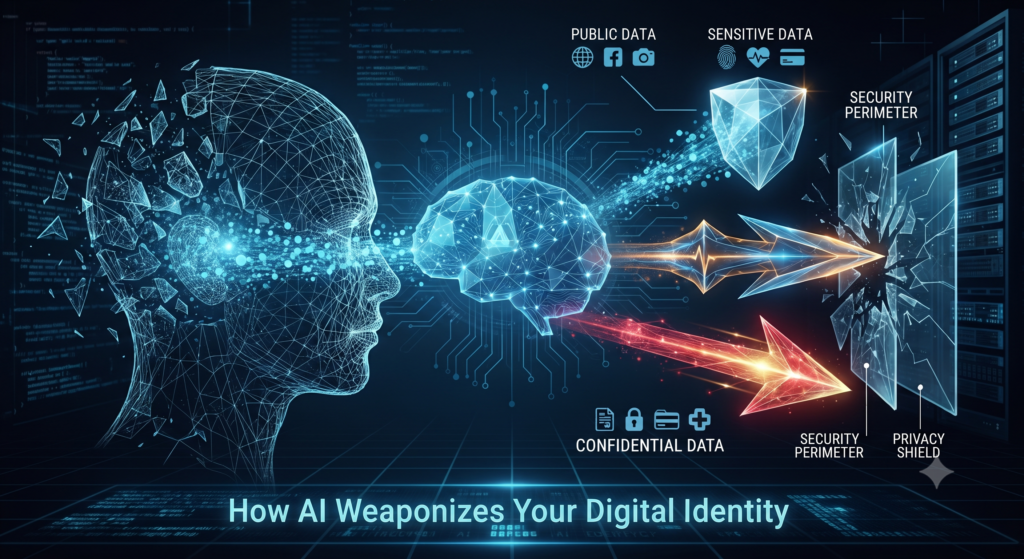
Your name may be public, your location may be sensitive, and your private documents may be confidential. However, AI does not see these categories separately. It connects them. A public photograph, a shopping habit, a workplace profile, and a location signal may seem harmless individually. Together, they create a highly detailed, actionable map of your life.
Here is how AI is fundamentally changing digital identity and what you must do to protect your digital footprint.
What Is Digital Identity?
When most people hear the words “digital identity,” they think of a username and a password. That is only the surface.
Your digital identity is the entire collection of information, signals, accounts, devices, and behaviors that represent you online. This includes your email address, phone number, biometric data like your face and voice, your browsing habits, and even the unique cadence of how you type.
Every login, purchase, and photograph adds another signal. Every signal makes your digital identity easier to recognize, predict, and imitate. The question is no longer whether you have a digital identity, but who is assembling it and what they are inferring from the data.
The Three Tiers of Information
To understand the risk, we must break down how data is categorized and where the vulnerabilities lie.
1. Public Information
Public information is data intentionally made available to other people. This includes your name on a professional profile, a published article, or a photograph uploaded for anyone to see.
The first mistake people make is assuming that “public” automatically means “harmless”. A public detail becomes dangerous when combined with other public details. One photograph reveals your face, another reveals your workplace, and a location tag reveals where you live. AI can scan thousands of these public posts, recognize faces, compare locations, and summarize your behavioral routine in seconds. AI transforms public information into a private conclusion.
2. Sensitive Information
Sensitive information is data that could cause harm if exposed, misused, or combined with other data. This includes health information, financial details, biometric data, precise location, and private communications.
Unlike a password, you cannot simply replace your face or voice when it is stolen. AI can now analyze biometric data to estimate emotion, age, attention, and stress. You may never explicitly tell an AI system that you are under financial pressure or looking for a new job, but your search patterns, purchases, and location history may reveal it.
3. Confidential Information
Confidentiality is about access. It describes information restricted to specific people, systems, or organizations, such as passwords, private keys, customer records, or internal business documents.
The problem begins when individuals treat AI tools like harmless search boxes. Uploading an internal strategy document, pasting a private conversation, or asking an AI assistant to summarize customer records exposes confidential data. Usefulness does not remove the responsibility to protect the information.
How AI is Rewriting the Rules
AI is altering the landscape of digital identity in four major ways:
- Aggregation: AI combines information from disparate sources that were never designed to work together, such as a social profile, a public database, and a purchase history.
- Inference: AI does not need you to state facts directly. It estimates what is likely true regarding your habits, vulnerabilities, and relationships.
- Re-identification: Data that appears anonymous may not remain that way. Even if a dataset removes your name, your device patterns and timing can point directly back to you.
- Automation: AI can act on your identity. It can imitate writing styles, generate realistic voices, and automate social engineering at a massive scale, blurring the line between identity theft and identity simulation.
AI privacy has become a luxury that only a few people can afford.
How to Protect Your Digital Identity
Passwords protect access, but they do not control the predictions made about you. To reduce your exposure to automated systems, implement these active defense strategies:
- Practice Data Minimization: Share strictly less information than forms request.
- Isolate AI Interactions: Do not upload confidential documents to an AI tool unless you fully understand its data-handling policies and retention periods.
- Scrub Metadata: Remove unnecessary location metadata from photographs before uploading them.
- Segment Your Accounts: Use separate email addresses for highly privileged accounts, shopping, and public registrations.
- Protect Biometrics: Be highly cautious with public voice recordings and high-resolution facial images, as these can now be easily cloned.
- Enable MFA: Mandate Multi-Factor Authentication across all critical infrastructure and personal accounts.
If you want to know more about digital safety visit: www.security.org (not affiliated)
You may not be able to erase your entire digital identity, but you can reduce the amount of actionable telemetry available to build it. You can make the profile less accurate, less complete, and vastly less useful to anyone attempting to manipulate you.
Before you upload, publish, or share, ask yourself: If an intelligent system connected this information with everything else about me, what could it learn?
Stay ahead of the evolving threat landscape. For more insights on securing your digital infrastructure, explore the resources at Secure Cyber Mart.
Related Articles:
- Hunting Autonomous Threats: Defending Cloud Infrastructure
- The Insider Threat of Agentic AI: Why I’m Worried About GPT-5.6
- Instagram has removed End-to-End Encryption: What You Need
- BrowserGate: How LinkedIn Tracks You Forever
- Exploring the Ethics of AI: Balancing Innovation
- How to Become a Security & Fraud ML Specialist in Singapore